The Jinan Crucible: Seven Years of Bitterness
After fifteen years of intensive study under Chen Fa-ke in Beijing, Hong Junsheng moved to Jinan. It was here, in the shadows of a humble hutong, that his most profound work began. Branded as “unemployable,” Hong lived in a state of extreme poverty that would have broken most men. He survived in a hovel, at times eating chicken feed and laboring over matchboxes for pennies, his hands calloused by the repetitive work.
Yet, these seven years were not a period of stagnation; they were a period of re-creation.
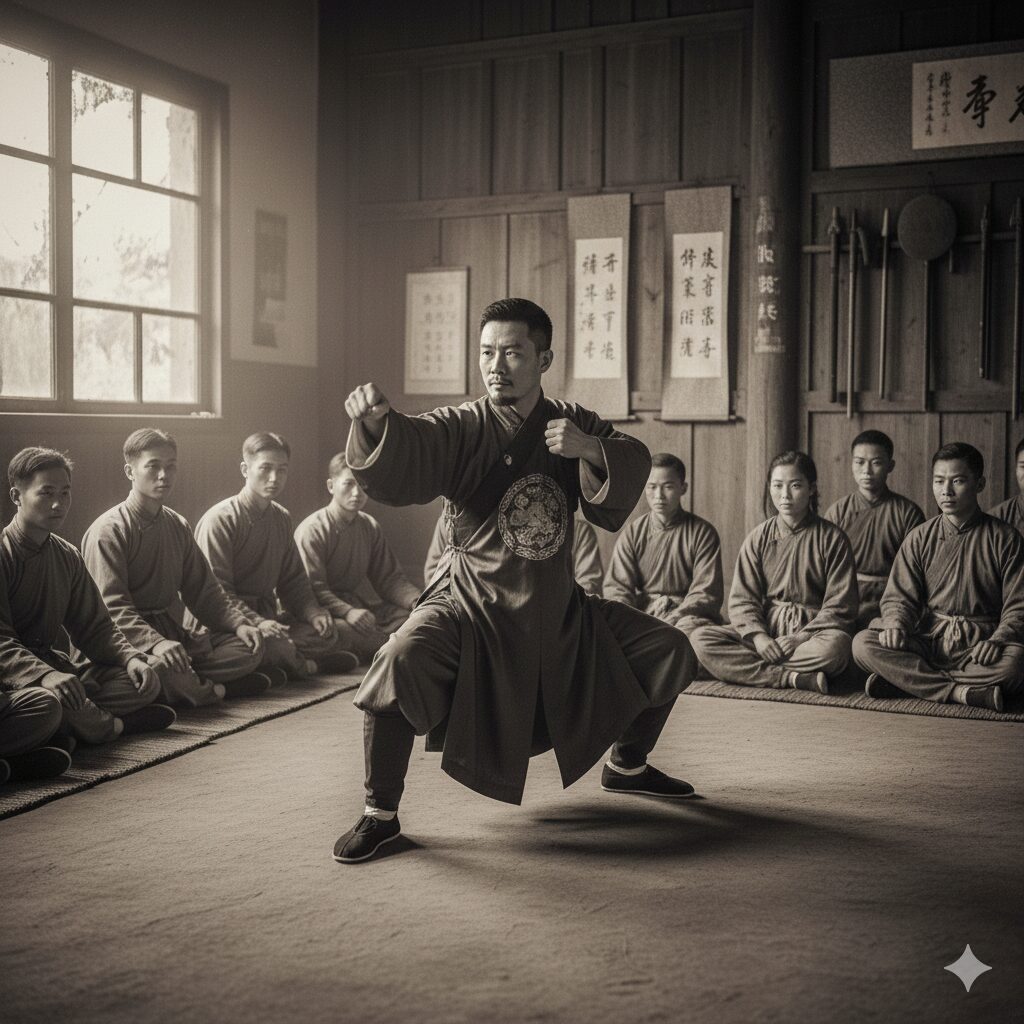
The Decoding of the Art
Isolated and penniless, Hong turned inward. He used this time to deconstruct every instruction he had ever received.
The Weight of Memory: He consulted his notes and his muscle memory, obsessively checking his movements against the standard Chen Fa-ke had set.

Function Over Form: Like his teacher, Hong had no patience for "flowery" movements. In his Jinan hovel, he stripped the art of its shells, focusing entirely on Applications and Push Hands.

Survival through Teaching: To supplement his meager income, he taught a small circle of students, using them as partners to verify the mechanics he was decoding.
The Return to Beijing
In 1956, overcome with grief following the death of his wife, Hong Junsheng returned to Beijing. He carried with him the fruits of those seven years in Jinan—a refined, mathematically precise understanding of the art.
When he reunited with Chen Fa-ke, the Master watched his student’s progress and delivered the ultimate validation: “There are no empty postures.” The “bitterness” of Jinan had preserved the art in its purest, most functional form.
===================
The Evolution of Mastery
The Youth ("Third Daughter"): As a youngster, Hong was small, sickly, and often underestimated. The nickname "Third Daughter" was a shadow he lived under—a constant reminder of his physical frailty in a culture that equated martial prowess with brute strength.

The Apprentice: He took that frailty to Chen Fa-ke in Beijing. For 15 years, he didn't just learn a form; he learned a way to survive. He became the scribe of the art, recording the minute details that others overlooked.

The Jinan Master ("Magic Hands"): By the time he was "eating bitterness" in the Jinan hutongs, the transformation was complete. He was still small, and he was still poor, but he was formidable. The "Magic Hands" were the physical manifestation of his 15 years of decoding. He didn't need weight to move an opponent; he used the "steering" of the weighted side and the "power" of the sunk side to make his attackers feel as though they were fighting a ghost.
Leave a Reply